How to Choose Between R, S, K, and F Series Helical Gearboxes
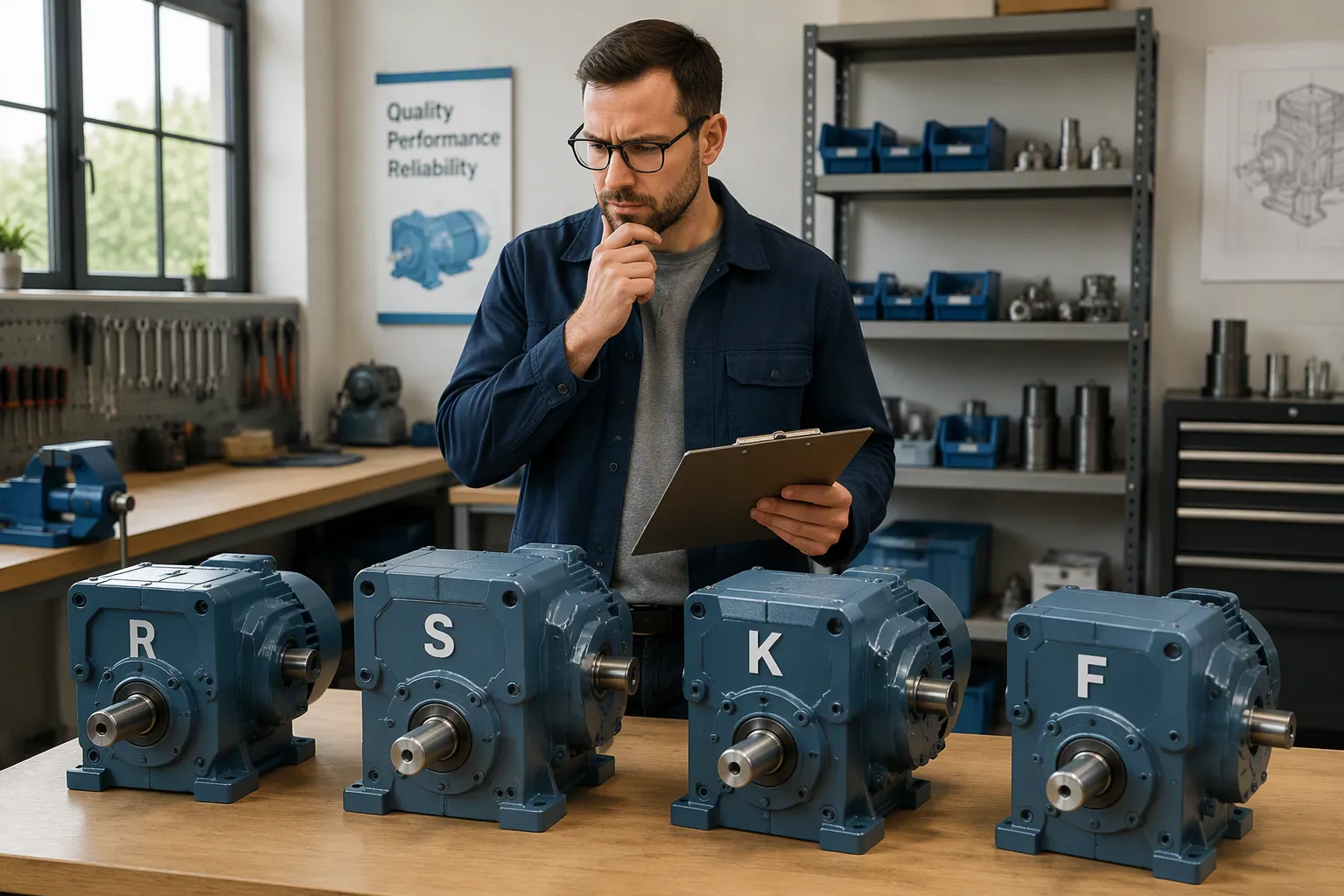
R, S, K, and F series each fix a different mechanical problem. So the right choice depends on matching the series design to what your application needs. Which one fits your drive? Answer five questions before you open any catalog: torque, ratio, service factor, mounting, and environment. Treat these as your evaluation criteria from the start. A wrong match shows up later as noise, wear, or downtime. This guide gives you a factor-by-factor comparison and a practical selection path for a helical gearbox, not a generic product overview. Work through the factors in order, and the series choice becomes a conclusion rather than a guess.
Key Takeaways
Start with the load: find the torque and speed your machine needs.
Use the service factor to pick a gearbox that can handle shock and continuous duty.
Match the series to the job: R for inline high speed, S for compact self-locking, K for high torque right angle, F for narrow spaces.
Check mounting and environment early to narrow your choices.
Follow the six-step selection guide to avoid noise, wear, and downtime.
What Each Series Does
R Series: Inline Helical
The R series uses a coaxial, inline layout. Power moves straight from the motor to the load, and the design handles high-speed transmission in pumps, blowers, and mixers. Efficiency stays above 95% at normal running speeds, so continuous duty costs you less in electricity and oil breakdown. See the R series inline helical gearbox for configuration details.
S Series: Helical-Worm
The S series pairs a helical stage with a worm stage. You get a high reduction ratio in a compact housing, plus self-locking safety for vertical lifting and hoists. The hybrid design stays more energy-efficient than a pure worm unit. At a 50:1 ratio, expect about 88% efficiency. Review the S series helical-worm gearbox when you need holding force without an external brake.
Two more series complete the line. The K series is a helical-bevel design with right-angle output, built for extreme shock loads in mining and heavy conveying. The F series is a parallel-shaft unit with a slim body that fits narrow installations. Across all four, the collective torque range runs from 200 to 50,000 Nm.
All four belong to the 谷戈Helical Gearboxes & Gear Motors (R/S/K/F Series) line. Every unit uses 20CrMnTi alloy steel, case hardened to 58–62 HRC, and CNC-ground to DIN 6 accuracy. That shared build standard means your series choice comes down to layout and load, not quality tier. Pick the F series parallel shaft gearbox or the K series helical-bevel gearbox on mounting geometry alone. Each helical gearbox in the line ships after 100% load, noise, and oil-leak testing.
Five Helical Gearbox Selection Factors
Torque, Ratio, and Service Factor
Begin with the load. You know how much torque the driven machine needs and how fast it runs. Divide the motor input speed by the required output speed to find the gear ratio. Then check that the gearbox's rated output torque meets or beats the load torque at that ratio.
Raw torque by itself will under-size the unit. The service factor compares rated torque to demanded torque, and AGMA works it out from gearbox type, duty, and application. Multiply the required torque by the service factor to get the rating you must specify. If the required torque is 1,125 lb-ft and the service factor is 1.5, you need a gearbox rated at 1,688 lb-ft.
Load Condition / Duty | Service Factor Guidance |
|---|---|
Uniform load, 8–10 hrs/day | 1.0 – 1.25 |
Moderate shock load, 8–10 hrs/day | 1.25 – 1.5 |
Heavy shock load, 8–10 hrs/day | 1.5 – 1.75 |
Continuous duty, 24 hrs/day | Add 0.25 to above |
Frequent starts/stops (10+/hr) | Add 0.25 – 0.5 |
Reversing operation | Add 0.5 or specify reversing-duty unit |
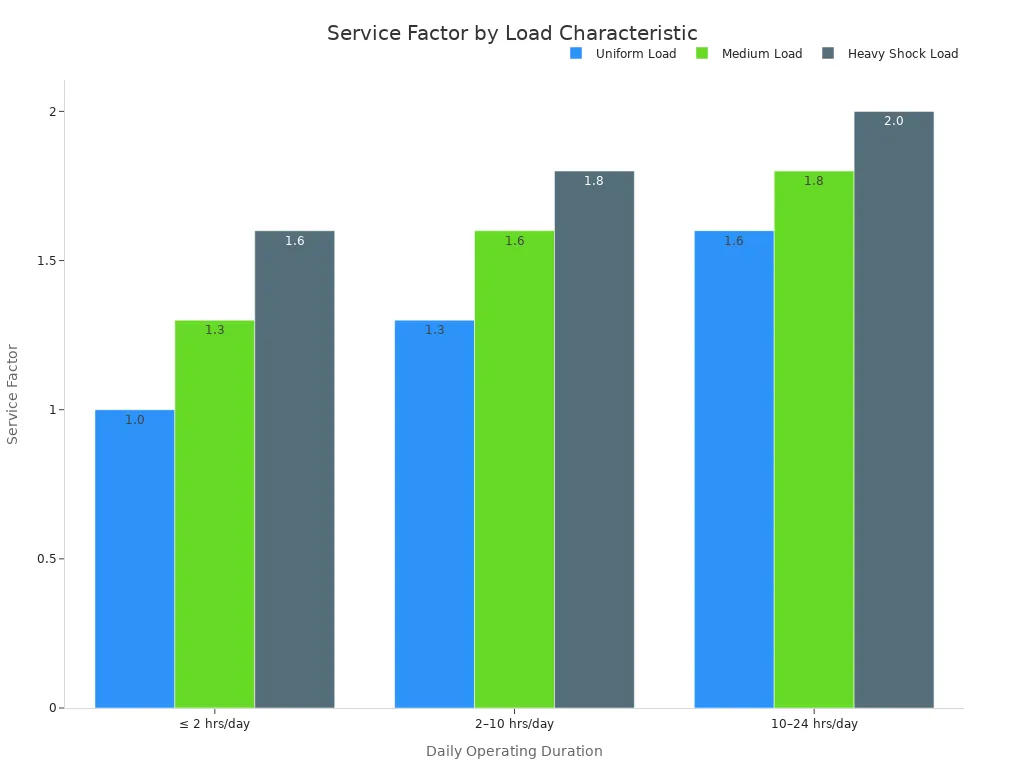
Also check peak torque. Startup, reversing, and jams can go past average torque even when your math looks fine. Compare the acceleration torque to the gearbox's momentary peak rating.
Mounting and Environment
Mounting style narrows the series quickly. Foot, flange, hollow shaft, solid shaft, and combined versions each fit a different frame. Orientation matters too, since it affects lubrication, heat dissipation, and maintenance access. A right-angle need points to the K series; a narrow frame points to the F series.
Environment sets the material and sealing spec. Dust, moisture, washdown, and temperature swings all call for protection. For washdown duty, ask for stainless steel shafts and housings. 谷戈 supports this with SS304/316 shaft options, NEMA/IEC/Servo output flanges, and precision-adjusted ratios, so your helical gearbox matches the frame and the site.
Comparing Helical Gearbox Series
Where Each Series Fits Best
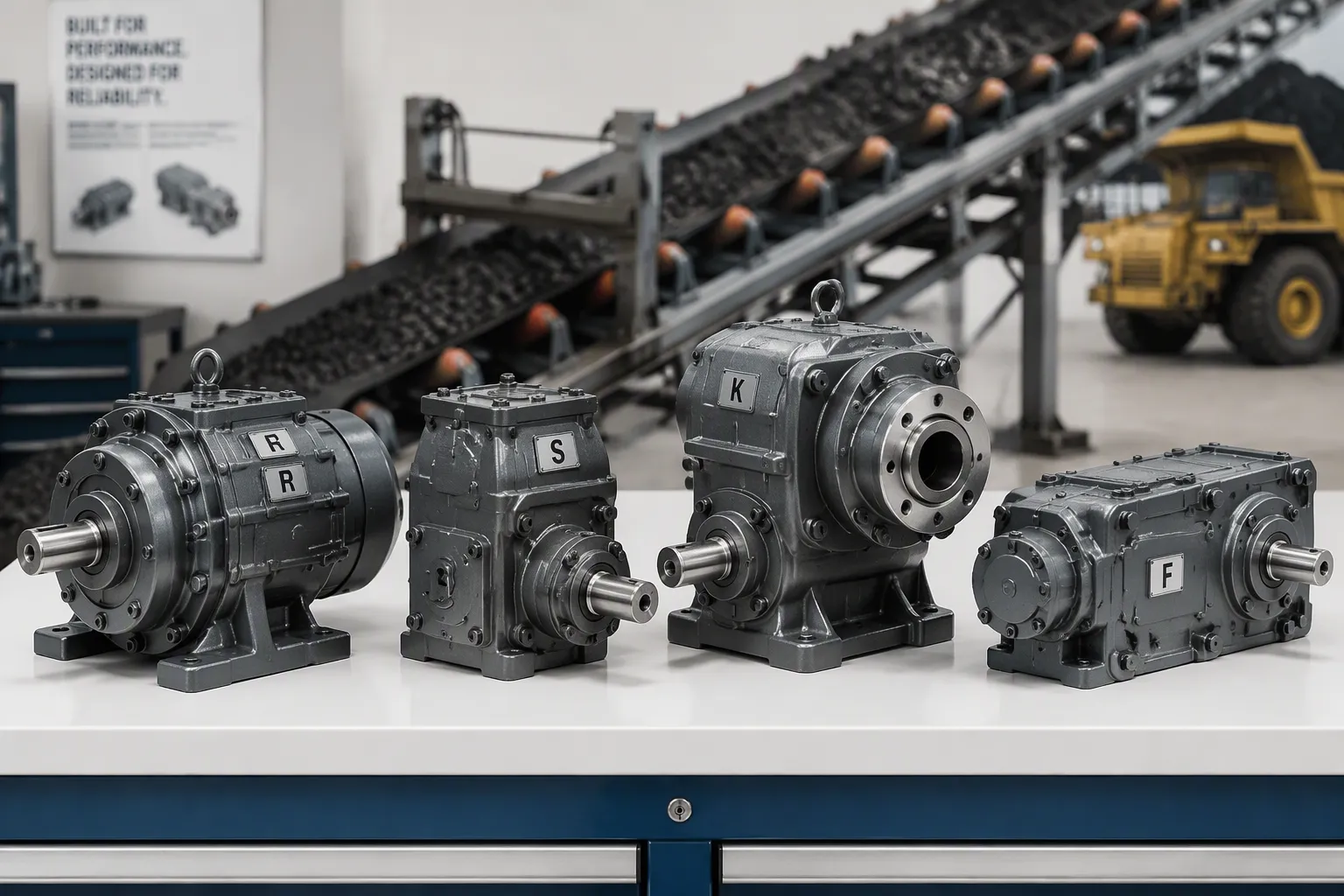
All four series are built the same way, but each one is best for a different job. The R series runs inline, so it works well for high-speed transmission in mixers, agitators, and belt or roller conveyors. The S series pairs a helical stage with a worm stage. That right-angle layout with self-locking behavior fits packaging lines, filling equipment, and compact transfer systems. The K series sends power through a right angle with helical-bevel gearing. Mining conveyors, cement plants, and heavy continuous duty belong here. The F series uses a parallel shaft layout with a slim body. It fits into narrow frames where a right-angle unit will not fit.
Series | Max Output Torque | Ratio Range | Efficiency | Mounting Options | Typical Application |
|---|---|---|---|---|---|
R (inline helical) | — | — | >95% | Foot, flange, geared motor | Mixers, conveyors, packaging |
S (helical-worm) | — | — | High, with self-locking | Foot, B5/B14 flange, M1–M6 positions | Packaging, filling, compact right-angle drives |
K (helical-bevel) | 53,000 Nm | 3.98–197.37 | Over 90% (two-stage gearing) | Foot, B5/B14 flange, solid or hollow shaft | Mining, cement, heavy conveyors |
F (parallel shaft) | — | — | — | Foot, flange, shaft-mounted | Narrow conveyor frames, agitators |
Input power follows the same pattern. The K series covers 0.12–90 kW on its three-stage frames. Duty cycle separates them further. The K series handles continuous 24/7 shock-loaded service, while the S series works best in intermittent compact drives.
Quick Decision Matrix
Match your main constraint to one rule. High torque plus a right-angle need points to the K series. Inline layout plus high speed points to the R series. Self-locking plus a compact footprint points to the S series. Narrow space plus a parallel shaft points to the F series.
Every series in this helical gearbox line delivers over 95% efficiency and passes 100% load, noise, and oil-leak testing before shipment. Your series choice therefore rests on layout and load, not on a quality gap between models.
Step-by-Step Selection Guide
From Load Data to Final Series
Go through the steps in order. Each step makes the choices fewer before the next one starts.
Find the load type and its values. Label the duty as uniform, moderate shock, or heavy shock. Write down the effective pull, pulley diameter, and required output speed.
Figure out the ratio and torque. Divide motor speed by required output speed to get the ratio. Then size the torque:
Output Torque ≈ Input Torque × Gear Ratio × Efficiency
Example: 100 lb-ft input × 20:1 ratio × 96% efficiency = 1,920 lb-ft approximate output torque.
Use the service factor. Multiply required torque by the factor for your duty class. A 200 Nm load at a 1.75 factor needs a 350 Nm rating, which often moves you up to the next frame size.
Check mounting and environment. Make sure the foot, flange, hollow shaft, or solid shaft fits. Then set the protection class for dust, washdown, or temperature.
Match to a series. Right angle and high torque mean K. Inline and high speed mean R. Self-locking and compact mean S. Narrow frames mean F.
Check with the supplier. Confirm continuous and peak torque, thermal capacity, and shaft loads against the published rating.
A real field case shows the payoff. An Australian mining OEM needed 50 customized K127 bevel gear motors. The units worked with existing NEMA motors, ran 36 months with zero failures, and cut procurement cost 35% against earlier European suppliers. Review the selection data before you finalize any helical gearbox order.
Application Examples by Series
Each series earns its place in a certain duty. Use these examples as a guide for your own match.
R series — mixers and agitators. The inline layout gives high speed with over 95% efficiency, so continuous mixing duty runs cool and quiet.
S series — packaging lines. The helical-worm stage gives a compact right-angle drive with self-locking safety for hold-and-release stations.
K series — mining conveyors. Right-angle helical-bevel gearing carries high torque through shock loads that would wear out a lighter unit.
F series — narrow conveyor frames. The parallel shaft body fits into tight installations where a right-angle housing will not fit.
Run your numbers through all six steps before you commit. Correct matching gives you reliability and lower cost; a shortcut gives you noise, wear, and downtime.
Begin with the load. Next, check the torque and ratio. Then apply the service factor, and after that confirm the mounting and environment. Match the series whose design fits those answers. Do not just pick one series out of habit. A correct match gives you reliability and good cost; a wrong match brings noise, wear, and downtime.
Treat the series as your last decision, not your first. Send your load data, duty cycle, and mounting details to a gearbox specialist. Ask for a helical gearbox recommendation based on your numbers, and confirm the fit before you order.
FAQ
Which series handles the highest torque?
The K series handles up to 53,000 Nm because of its helical-bevel, right-angle design. Pick it for mining conveyors, cement plants, and other heavy jobs with shock loads.
Can you match my existing motor and frame?
Yes. 谷戈 offers NEMA, IEC, and Servo output flanges as a customization option. The team can also change output shaft heights and diameters so it drops right in. Send your motor frame and mounting drawing, and engineering usually answers within 24 hours.
Do I need a service factor above 1.0?
Yes, for almost every real load. A steady load at 8–10 hours a day starts near 1.0–1.25. Add extra room for shock, continuous 24-hour duty, frequent starts, or reversing. Size the gearbox rating against the required torque times that factor.
What testing does each unit receive before shipment?
Every gearbox in the R/S/K/F line gets 100% load, noise, and oil-leak testing before it leaves the factory. Gears are CNC-ground to DIN 6 accuracy from 20CrMnTi alloy steel, case hardened to 58–62 HRC. Efficiency stays above 95%.
How do I get a series recommendation for my application?
Send your load type, required output speed, duty cycle, mounting orientation, and site conditions. The team matches those values to a series and confirms continuous torque, peak torque, and thermal capacity. Send in your application details to get selection advice before you order.