

Worm Gearbox vs Planetary Gearbox Which Is Better for Your Application
Neither gearbox is best for every job. The right pick depends on what the application needs. A worm reducer gearbox may fit one machine perfectly. A planetary unit may work much better for another. This comparison looks at both types in terms of efficiency, gear ratio, self-locking, size, cost, and common use cases. Readers will see how each design acts under real working conditions. The goal is practical clarity, not a technical lecture. By the end, a simple checklist will help match a gearbox type to specific load, speed, and space needs. That approach turns a hard decision into an easier one.
Key Takeaways
Worm gearboxes are great at high gear ratios and self-locking. This makes them perfect for lifting and holding loads.
Planetary gearboxes work very well and are very accurate, making them perfect for running all the time and putting things exactly where needed.
Think about how often your application runs: use a worm gearbox for stop-and-go use, and a planetary gearbox for nonstop running.
Check space limits: worm gearboxes save space along the shaft with a right-angle design, but planetary gearboxes are slim and longer.
Pick based on your needs: choose worm for low cost and self-locking, and planetary for efficiency and low backlash.
What Is a Worm Reducer Gearbox
How Worm Gears Work
A worm reducer gearbox is a small speed reducer that turns power direction at a right angle. A threaded worm shaft spins against a worm wheel to lower speed. This design gives high torque increase in small spaces. Companies like Changzhou Changyulong Reducer Co., Ltd. make these units in NMRV, WP, and SWL series models.
The sliding contact between the worm and wheel creates friction. This friction causes loss of efficiency. Modern worm gear reducers reach about 90% efficiency at very low ratios. At high ratios, efficiency falls to 30-50%. The usual range is between 50% and 90% depending on the design and ratio. The sliding action turns some input power into heat instead of mechanical output.
A key feature of worm gear reducers is self-locking ability. The friction between the worm and wheel stops back-driving under load. This trait helps hold loads without extra brakes. The gearbox also runs quietly, making it good for places where noise matters.
Each worm gear reducer uses high-quality materials to last long. High-grade tin bronze (ZQSn10-1) forms the worm wheel. Hardened and ground alloy steel makes up the worm shaft. These materials resist wear and give long-term durability.
Common Worm Gearbox Uses
Self-locking makes worm gearboxes great for many tasks that need lifting or holding loads. As one source notes, "Self-locking, or the prevention of back driving, is useful in applications that require lifting and/or holding loads."
Common uses cover many industries. Here is a table showing typical uses:
Industry / System | Application |
|---|---|
Automotive | Power steering systems |
Industrial machinery | Conveyor systems |
Industrial machinery | Machine tools (e.g., milling, drilling) |
Construction | Hoists and cranes for lifting heavy loads |
Marine / Off-road | Winches for sailing boats, off-road vehicles, and construction sites |
Scientific / Optical | Telescope mounts |
The chart below shows the spread of worm gearbox uses across different industries:

Other uses include elevators, security gates, industrial mixers, food packaging lines, and stage systems. A self-locking worm gear reducer fits jobs that need direction change, speed reduction, and holding power. Each worm gear reducer from Changzhou Changyulong offers customization for specific needs. The worm gear reducer gives high torque in a small space. A reliable worm gear reducer runs smoothly under load. The worm reducer gearbox mixes torque, safety, and compact design in one reliable package.
What Is a Planetary Gearbox
How Planetary Gears Work
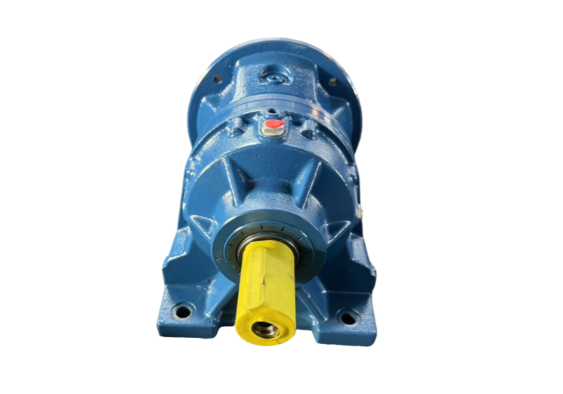
A planetary gearbox has a center sun gear, several planet gears, and an outer ring gear. The planet gears spin around the sun gear and touch the ring gear at the same time. This makes the gear teeth roll against each other. Rolling creates much less friction than the sliding that happens in worm gears. Less friction means less power wasted as heat. So a planetary gearbox turns more input power into useful output torque.
Several planet gears share the load at once. Each tooth only feels a small part of the total force. This sharing gives planetary gearboxes higher torque density than parallel shaft designs. The table below shows how they differ.
Attribute | Planetary Gearbox | Parallel Shaft Gearbox |
|---|---|---|
Torque density | Higher | Lower |
Physical size for equal torque | Smaller | Larger |
This compact, high-torque design works well in machines with little space. Planetary gear systems also handle faster input speeds than worm units. A precision planetary gearbox adds low backlash for exact motion control.
Even though planetary gearboxes have great torque density, they still add length to a setup, just like all gearboxes do.
Common Planetary Gearbox Uses
Planetary gearboxes help industries that need efficiency and exact motion. A planetary gearbox works for jobs that need quick response and repeatable positioning. Common fields include:
Automation and robotics (exact positioning, smooth motion)
Packaging machinery (fast production, nonstop operation)
Medical equipment (compact, quiet, dependable motion)
Material handling (conveyors, gantries, automated storage)
AGVs and AMRs (compact drives for self-driving mobile robots)
Aerospace and machine tools also depend on these units. Precision servo positioning needs low backlash and high stiffness. A planetary gearbox gives you both. Engineers choose planetary gearboxes when speed, accuracy, and small size matter more than self-locking.
Worm Gear vs. Planetary Gears at a Glance
Quick-Reference Comparison Table
A side-by-side view helps buyers spot the main differences quickly. The table below compares planetary and worm gear setups on the factors that matter most when choosing.
Criterion | Worm Gearbox | Planetary Gearbox |
|---|---|---|
Efficiency | 40% to 90%, depends on ratio; sliding contact makes friction and heat | Up to 98% per stage; rolling contact |
Gear Ratio | 5:1 to 100:1 in one stage | 3:1 to over 1000:1 across several stages |
Self-Locking | Built in; holds loads without extra brakes | Usually can be backdriven |
Size and Layout | Right-angle; saves space along the axis | Inline; slim around the axis, adds length |
Cost | Medium; sits between spur and planetary | Higher; more gears, pins, bearings, and carrier parts |
Backlash | Medium; often measured in degrees | Low to medium; precision types are tighter |
Typical Applications | Lifting, hoists, conveyors, mixers, stage systems | Robotics, servo positioning, aerospace, automation |
How to Read the Table
No single row decides the winner. Each reader must weigh the factors by their own needs. A lifting job may put self-locking above everything else. A conveyor that runs all day may care about efficiency first. The table simply puts the trade-offs in one place.
Efficiency stands out as a big divider. Worm units lose more input power as heat because their teeth slide against each other. Planetary units roll instead, so they waste much less energy. A buyer running a machine all day should look at this row closely.
Gear ratio tells another story. Worm gearboxes reach high reduction ratios, compact design, and self-locking in one stage. Planetary gearboxes need several stages to match that ratio. Each added stage brings more parts and more cost.
Backlash deserves careful attention. A standard right angle worm gear reducer often has backlash measured in degrees rather than arcminutes. Precision planetary units hold much tighter values. Buyers should know that gearboxes with a backlash value under 5 arc-minutes will cost more than gearboxes with high backlash values. Tasks that position in both directions usually justify that extra spending.
Cost follows complexity. Worm gearboxes usually land between spur and planetary units on price. Planetary gearboxes carry a higher price tag because they pack in more gears, pins, bearings, and carrier parts. Low-backlash grades add tighter tolerances and more inspection, which pushes cost higher still.
Size and mounting shape the final call. Worm units turn power at a right angle, which suits machines with little room along the axis. Planetary units run inline and stay slim around the axis. Neither layout wins everywhere.
Readers comparing worm versus planetary gears should start with their hardest limit. That limit might be space, budget, holding safety, or positioning accuracy. The table then narrows the field quickly. A short list of two or three candidate models makes the next step, talking to a supplier, far more productive.
Efficiency: Worm Gear Reducer vs Planetary Gearbox
Why Worm Gears Lose Efficiency
A worm gear reducer works by sliding the worm shaft against the worm wheel. This sliding action causes friction. Friction changes useful power into heat. That heat is wasted energy. So worm gear efficiency is usually between 50% and 90%. The exact number depends on the gear ratio and how well it is made.
Several things affect worm gear efficiency. The table below lists the main ones.
Factor | Effect on worm gearbox efficiency |
|---|---|
Sliding friction in the worm mesh | Higher sliding friction is the main reason for lower efficiency compared to rolling-mesh gearboxes. |
Diameter-to-center-distance ratio | A lower ratio helps gear efficiency. |
Lead angle | A larger lead angle cuts friction and boosts efficiency. |
Gear ratio | Lower ratios with multi-start worms usually improve efficiency. |
Material pairing | A bronze worm wheel and a case-hardened worm generally give higher efficiency. |
Operating conditions | Faster input speed and higher output torque often raise overall efficiency. |
Lubricant | Synthetic oils, like polyglycols, can give better efficiency than mineral oils. |
Contact pattern | A larger contact pattern usually reduces losses. |
Roughness | Smoother worm flanks lower friction and power loss. |
A worm gear reducer still works well in many machines. It gives up some efficiency to be small and self-locking.
Why Planetary Gears Stay Efficient
Planetary gearboxes are usually more efficient than worm gearboxes in factory machines. Their gear teeth roll against each other instead of sliding. This rolling contact is why the two types differ so much in efficiency. A planetary gearbox can get up to 98% efficiency per stage.
Several planet gears carry the load together. This sharing cuts stress on each tooth and reduces energy loss. So a planetary gearbox turns more input power into useful work. Its efficiency stays high even when running hard.
The use case decides how much this difference matters. Machines that run all day do better with planetary gearboxes because wasted energy adds up over time. Lifting jobs that run on and off may accept worm gear reducer losses. In those cases, the self-locking feature of worm gear reducers often beats the efficiency loss. Buyers comparing a worm gear reducer vs planetary gearbox should think about run time versus holding needs.
Gear Ratio, Torque, and Backlash
High Ratios in One Stage
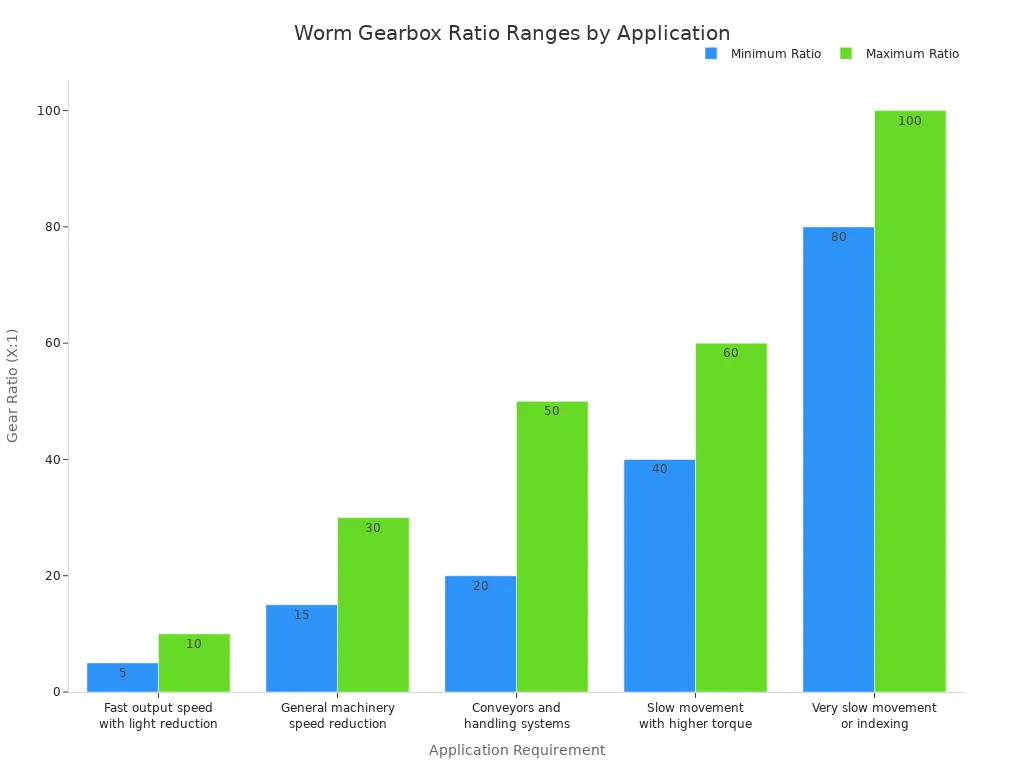
A single-stage worm gearbox usually reaches gear ratios from 20:1 to 80:1. For most industrial worm drive jobs, the best range is between 30:1 and 50:1. In that range, efficiency stays above 75%, and the unit stays compact. A single-start worm with a 20-tooth wheel gives 20:1 at the low end. An 80-tooth wheel gives 80:1 at the high end. For many general jobs, ratios between 20:1 and 60:1 give the best mix of output speed, torque, size, and cost. The table below shows how ratio choices match different application needs.
Application Requirement | Suggested Ratio Range |
|---|---|
Fast output speed with light reduction | 5:1 to 10:1 |
General machinery speed reduction | 15:1 to 30:1 |
Conveyors and handling systems | 20:1 to 50:1 |
Slow movement with higher torque | 40:1 to 60:1 |
Very slow movement or indexing | 80:1 to 100:1 |
A planetary gearbox needs multiple stages to reach these high ratios. Each stage you add brings more parts, more length, and more cost. So the worm gearbox wins on simplicity when the job needs high reduction in a compact right-angle package.
Engineers pick a worm gearbox when the main goal is high reduction in a single step. A planetary gearbox works better when low backlash and high precision matter more. Each design serves a different need. Knowing these trade-offs helps buyers make the right choice.
Precision and Backlash Needs
Backlash is the lost motion between input and output shafts. A worm gearbox usually has backlash measured in degrees, not arcminutes. Planetary gearboxes offer much tighter values. This makes them the better choice for precise motion control.
The table below shows backlash ranges for different precision classes.
Gearbox Precision Class | Typical Backlash Range |
|---|---|
Standard unit | 8–15 arcminutes |
Precision planetary gearbox | 3–8 arcminutes |
Ultra-precision unit | 1–3 arcminutes |
Aerospace and defense applications require planetary gearboxes to deliver exceptional precision for satellite positioning systems aircraft actuators and missile guidance mechanisms. These applications typically require backlash levels below 3 arcminutes to ensure reliable performance in critical operations.
Modern jobs demand sub-arcminute positioning accuracy. Precision manufacturing, satellite positioning, and advanced robotics need backlash levels measured in arc-seconds. Precision planetary gearboxes with ultra-low backlash handle these tasks. The key differences between worm and planetary units come down to their internal geometry. Worm gearboxes use sliding contact, which naturally creates more clearance between teeth. Planetary gearboxes use rolling contact with multiple tooth engagements. This design allows tighter manufacturing tolerances and much lower backlash values.
Self-Locking and Holding Ability
When Self-Locking Matters
A worm gear reducer has a built-in self-locking feature. This feature stops the output shaft from turning backward when a load is on it. This self-locking action makes it perfect for lifting and holding things up and down. The rubbing between the worm and the wheel makes enough resistance to hold a load without needing extra brakes.
A few things change how well self-locking works. A worm gear reducer with a ratio of 40:1 or higher usually self-locks in a reliable way. High ratios make a small lead angle that fights back-driving well. Low ratios like 5:1 to 10:1 let the load drive backward and lower holding power. Worm gear reducers work best when loads are static or mostly static. Shaking, sudden hits, and changing loads can weaken self-locking. The friction changes from static to moving in those moments. For jobs where safety is critical, you still need extra brakes. AGMA suggests an outside brake to hold the full load.
Changzhou Changyulong makes each worm gear reducer with high-grade tin bronze worm wheels and hardened alloy steel worms. These materials last a long time and hold up well against wear compared to standard gearbox materials. The strong build keeps it working for years in heavy lifting jobs.
When Backdrivability Matters
Planetary gearboxes can usually be backdriven. This means the load can turn the input side. Backdrivability is important for safe human-robot teamwork in collaborative robotics. It lets the system give a little when forces push from the load side. High gear ratios create a lot of reflected rotor inertia. That makes actuators almost impossible to backdrive. Keeping backdriving torque low is key for safety and force control.
Planetary gearboxes allow backdriving because they have low internal friction. Their starting torques are below 2% of nominal input torque. Cycloidal gearboxes reach 10–20%. Strain wave gearboxes go up to 27%. The low friction loss and high efficiency at partial loads bring down backdriving torque. Even with high ratios, the planetary gearbox's low friction beats inertia. This allows backdriving where other technologies get too stiff.
A worm gear reducer cannot backdrive because of its sliding contact design. Worm gear reducers play a different role. They are great at holding loads in place. Engineers pick planetary gearboxes when backdrivability and precision matter more than self-locking.
Size, Weight, and Mounting
Right-Angle vs Inline Layouts
A worm gearbox changes the direction of power by 90 degrees. The input shaft and output shaft are set at a right angle to each other. This setup saves room along the machine's axis. A right angle worm gear reducer works well in tight spaces where a straight drive cannot fit. Conveyors, mixers, and lifting systems often need this shape.
A planetary gearbox runs in a straight line. The input and output shafts are on the same axis. This design stays thin around the axis but makes the setup longer. Engineers choose planetary units when side space is tight and lengthwise room is open. Each layout fits a different machine shape.
Space and Weight Constraints
Weight is important in many applications. A lighter gearbox puts less load on frames, bearings, and support structures. Planetary gearboxes often weigh less than worm units for the same torque rating. The table below shows a typical comparison.
Gearbox Type | Output Torque Rating | Typical Weight |
|---|---|---|
Planetary gearbox | 200 Nm | as little as 2.5 kg |
Worm gearbox (equivalent capacity) | 200 Nm | 4–6 kg |
This comparison shows weight savings of about 1.5–3.5 kg, or roughly 40–60% lighter, when using a planetary gearbox instead of a worm gearbox for the same torque rating. Mobile equipment and robotics often gain from this lower weight.
Changzhou Changyulong's worm gearboxes have strong cast iron housings. These housings handle heavy-duty jobs and stand up to impact. The company also makes lightweight, rust-resistant designs for food packaging and marine environments. This mix of strength and low weight helps them last a long time in harsh conditions. Buyers who need a compact right-angle drive with proven durability should compare these housing options with their mounting space and load needs.
Cost, Maintenance, and Lifespan
Upfront Cost vs Total Cost
A worm gear reducer usually costs less to buy than a planetary one. The worm design uses fewer precision parts. A planetary gearbox has more gears, pins, bearings, and carrier parts. This complexity makes the price higher. Buyers with a tight budget often choose a worm gear reducer.
Changzhou Changyulong Reducer Co., Ltd. sells its worm gearboxes at factory prices. The company has ISO 9001:2015 certification and meets CE standards. It ships to more than 50 countries. These facts make buyers trust the product quality and reliable supply. A worm gear reducer from this supplier gives good value with no extra costs from middlemen.
Total cost is more than just the buying price. A planetary gearbox saves energy when used for many years nonstop. Its higher efficiency lowers electric bills. A worm gear reducer may cost less at first but uses more power over time. Buyers should compare the starting price with the energy cost over the machine's lifetime.
Service Life and Maintenance
Worm gears and planetary gears wear down differently. Worm gears use sliding contact. The worm shaft rubs against the worm wheel with each turn. This sliding makes friction and heat. Over time, the bronze wheel and steel worm wear away. Good lubrication and cooling help them last longer. A look at wear resistance shows that material choice is very important. High-grade tin bronze worm wheels resist wear much better than regular bronze.
Planetary gears use rolling contact. Their teeth roll against each other with very little sliding. This creates less friction and less heat. The gears wear down more slowly under normal loads. A planetary gearbox often lasts longer when run all the time.
Both types need regular care. Oil changes, seal checks, and vibration checks keep either unit working. A worm gear reducer needs more careful lubrication because of its sliding friction. Planetary units can often go longer between services. Buyers who want low maintenance should think about this difference. How long a gearbox lasts depends on materials, load, and how it is used. A well-cared-for worm gear reducer still gives years of reliable service. Planetary gearboxes are very durable in high-use situations. Both designs will last a long time if they get the right care.
Spur Gearbox vs Planetary Gearbox vs Worm Gearbox
Where Spur Gearboxes Fit
A spur gearbox uses straight-cut teeth that fit together in a simple, direct way. This design gives high efficiency and a basic build. Spur gears work great in jobs that need exact timing, like conveyor systems, and they cost less to make. Assembly line machinery often uses spur gearboxes for this reason.
Spur gearboxes do have some downsides. They are bigger than planetary units for the same torque. They also make more noise at high speeds. A helical gearbox, which is a type of spur gear, fixes this. Helical teeth touch slowly and share the load across more teeth at once. This makes helical units more efficient than worm gearboxes.
The table below compares efficiency and noise across the three types.
Gearbox Type | Efficiency (Max) | Noise Level |
|---|---|---|
Planetary | 47.84% | Low noise |
Spur | 43.6% | Higher noise at high speeds |
Worm | 25.7% | Quiet operation |
Choosing Among the Three
The choice among these designs comes down to what the job needs most. A spur gearbox vs planetary gearbox vs worm gearbox decision often starts with torque and how the machine is used. High torque needs point toward planetary or worm units. Conveyor systems commonly use worm gearboxes, while spur gearboxes run assembly line machinery.
Each type has a clear role. Worm gearboxes give high reduction ratios from 10:1 to 100:1 and self-locking features. Planetary gearboxes offer compact, high-torque solutions with low backlash. Spur and helical gearboxes handle general high-efficiency work at a lower cost. A wear resistance comparison also matters here. Worm gears use sliding contact, while planetary and spur gears roll, so their wear patterns differ over time. Buyers should weigh ratio, efficiency, precision, and budget before they pick a type.
When to Choose a Worm Gearbox
Best-Fit Applications
A worm reducer gearbox is a great choice when a machine needs a big speed reduction in a small space. These units handle ratios from 5:1 to 100:1 in just one stage. They also turn power direction by 90 degrees. That right-angle setup saves useful space along a machine's axis. A worm gear reducer works well for slow jobs that need steady torque. The self-locking feature holds loads in place without extra brakes. This makes the design a natural fit for lifting and holding tasks.
Many industries depend on these traits every day. Heavy lifting platforms, stage systems, and screw jacks all gain from the holding power. Screw jack load capacities range from 0.1 kN to 500 kN in some designs, while heavier models reach 5 kN to 2000 kN. Marine environments and food packaging lines also use these units. Changzhou Changyulong's worm gear reducer supports screw lengths up to 6,000mm. The company also builds synchronized multi-jack setups for coordinated lifting. Each worm gear reducer gives reliable performance in these demanding roles.
Conditions That Rule It Out
A worm gearbox does not fit every job. Continuous-duty systems that run all day waste energy through sliding friction. A worm gear reducer vs planetary gearbox comparison shows the planetary unit wins on efficiency in those cases. High-speed applications also favor planetary designs. A worm gear reducer cannot match the low backlash of a precision planetary unit. Tasks that need exact two-way positioning should look elsewhere.
Buyers must weigh the good and bad points of worm gearbox designs against their real needs. The durability of these units stays a strong point in harsh settings. However, a worm gear reducer loses efficiency as ratios climb. The worm gear reducers from Changzhou Changyulong still offer solid value for on-and-off lifting and holding. Engineers should rule out this type when speed, precision, or all-day operation tops the priority list.
When to Choose a Planetary Gearbox
Best-Fit Applications
A planetary gearbox is a great choice when a machine needs to be efficient, fast, and precise, all in a small package with strong torque. These units roll their teeth instead of sliding them, so they waste very little energy. That makes them a good fit for robotics, precision servo positioning, aerospace systems, and precision automation. Engineers who compare the good and bad points of planetary gearbox designs often choose them for these exact jobs.
Precision is the most important thing in several tough tasks. A precision planetary gearbox gives the tight motion control that advanced equipment needs. Look at these high-precision uses:
Robotics: zero backlash is key for high precision, and balanced planetary gearing stops vibrations while keeping low backlash below 6 arcsec.
Robotic welding with a trunnion: a very high precision planetary gearbox gives better positional accuracy during rotation, so welding happens while the trunnion turns, not only at stopped positions.
These examples show why planetary gearboxes are a must in precision work. A precision planetary gearbox keeps motion smooth and repeatable. Precision planetary gearboxes also handle fast input speeds that worm units cannot match.
Conditions That Rule It Out
A planetary gearbox does not fit every job. Buyers should rule it out when the machine needs self-locking or a very high single-stage ratio. A planetary gearbox cannot hold a load without power because it backdrives easily. Lifting tasks that must stay put without brakes need a different design.
Single-stage ratio limits also rule out planetary gearboxes for some jobs. The practical upper limit of a single planetary stage comes from geometry. To raise the ratio, the ring gear must grow much larger relative to the sun gear. This change makes planet gears too large, too close together, or mechanically compromised. A single-stage planetary gearbox reaches a maximum practical reduction ratio of about 3:1 to 10:1 or 11:1. A 20:1 ratio cannot be achieved in one stage because it would need unrealistic gear geometry. The sun gear would be too small, the ring gear too large, or the planet arrangement too hard to package. Instead, two stages such as 4:1 times 5:1 are used. Buyers who need a very high ratio in one step should look at a worm gearbox instead.
Spur Gear Motor vs Planetary Gear Motor vs Worm Gear Motor
Matching Motors to Gearboxes
Picking between a spur gear motor, a planetary gear motor, and a worm gear motor begins with what the job needs most. Spur gear motors cost less and work fine for everyday tasks. Planetary gear motors are great for precision and efficiency. Worm gear motors give self-locking and high ratios in one small unit. Each type works best with motors that match its strengths.
A worm gear motor often uses standard AC motors for lifting jobs. The self-locking action holds loads without needing extra brakes. A planetary gear motor usually works with servo motors for exact positioning. A spur gear motor fits basic conveyor drives where cost is the main concern. Buyers should match motor speed and torque to the gearbox rating before ordering.
Integration Tips
Mounting a motor to a gearbox requires checking a few important things. The table below lists the main compatibility standards.
Compatibility Standard | Requirement or Check |
|---|---|
Flange standardization | Adapter flanges must meet IEC B5 or NEMA C-Face sizes so parts can be swapped. |
Coupling design | The coupling must fit the motor shaft keyway or spline and carry full torque. |
Concentricity | Centering pilots reduce radial runout and stop bearing wear. |
Backlash | Precision automation needs targets below 5 arc-minutes. |
Torsional stiffness | High stiffness across shaft, coupling, and input ensures accurate torque transfer. |
Thermal management | The worm stage makes heat; housing surface area controls temperature rise. |
Changzhou Changyulong's worm gearboxes work with global NEMA, IEC, and servo motors. They offer modular input and output options for flexible integration. This compatibility supports long-term durability across different motor brands. Proper alignment and coupling selection protect that durability over years of service. Buyers should confirm flange standards and backlash needs before finalizing a motor and gearbox pairing.
Selection Checklist for Your Application
Key Questions to Ask
Every gearbox choice begins with asking the right questions. Engineers need to know the working conditions before they compare options. The table below puts each key question into the area it affects most. Answering all of them gives a full picture of what the application needs.
Category | Key Questions |
|---|---|
Motor and power | What motor type and speed run the system? What are the continuous and peak torque values? |
Speed and ratio | What output speed does the machine need? What gear ratio is needed to get there? |
Operation pattern | Is the duty cycle continuous or on-and-off? How often does the direction change? |
Precision | How much backlash can the application handle? Does it use servo control? |
Environment | What are the heat conditions? What is the mounting direction and free space? |
Safety | Does the application need self-locking? How long must it last? |
Interface | What are the input and output shaft connections? |
These seven groups cover every big factor. The duty cycle question matters most of all. A machine that runs 24/7 does better with a planetary gearbox because its high efficiency keeps temperatures low. A job that runs a few minutes each hour fits a worm gearbox, since heat is rarely a problem at low duty cycles. The table below gives this guidance in plain form.
Duty Cycle Type | Recommended Gearbox | Key Reasons | Typical Applications |
|---|---|---|---|
Continuous duty (e.g., 24/7 operation) | Planetary gearbox | High efficiency; low running temperature; steady lubrication; long bearing life; less heat from rolling contact | Automated factories running all the time |
Intermittent duty (e.g., a few minutes per hour) | Worm gearbox | Self-locking ability; low-cost build; heat is rarely a problem at low duty cycles | Automatic doors, adjustable furniture, medical beds |
A buyer who works through these questions with real load and speed numbers has a strong starting point. The answers also help narrow the field to one gearbox type before talking to a supplier. This way saves time and avoids costly mistakes.
Matching Requirements to Type
Once the answers are ready, the matching step starts. A worm gearbox fits jobs that need a high ratio, self-locking, and low cost. The design gives compact right-angle layouts and quiet running. It handles on-and-off loads well and does not need high precision. For lifting platforms, conveyors, and screw jacks, the worm gearbox is a natural fit. Its self-locking feature removes the need for outside brakes in vertical lifting tasks.
A planetary gearbox fits jobs that need efficiency, precision, and a small size. A precision planetary gearbox gives low backlash and high torque density. It runs well at high speeds and handles continuous duty cycles without getting too hot. Robotics, servo positioning, and precision automation rely on these traits. The planetary design also lasts long because rolling contact cuts wear over time. Engineers pick it when accuracy and energy savings matter most.
The table below sums up the key differences between the two types.
Feature | Worm Gearbox | Planetary Gearbox |
|---|---|---|
Efficiency | 50-70% | 95-98% |
Self-locking | Possible in some designs | Usually not self-locking |
Duty cycle | Better for on-and-off duty | Stable in continuous/repeated cycles |
Backlash | Usually higher | Low-backlash options available |
Cost | Lower in standard applications | Higher, but better for precision motion |
A buyer should match their priority list to one side of this table. Self-locking and low cost point toward worm. Efficiency and precision point toward planetary. Durability in high-speed continuous use also points toward planetary.
When the matching is done, the best next step is to talk to a gearbox supplier. Changzhou Changyulong Reducer Co., Ltd. can review specific load and speed data. They help confirm the selection before any purchase is made. That final check catches mistakes early and saves money over the machine's life.
No single gearbox type is the best for every job. The right pick matches what the machine needs most. Worm gearboxes work well for high ratios and self-locking safety. They cost less at the start and fit lifting tasks that run on and off. Planetary gearboxes give better efficiency and precision. Their small design delivers high torque for systems that run all day. Readers should first run their needs through the selection checklist. The checklist covers load, speed, duty cycle, and space. Talking to a gearbox supplier with real load and speed data leads to the most reliable choice. Changzhou Changyulong reviews real working conditions and confirms the selection. That last step stops costly mistakes.
FAQ
Which gearbox type suits most general applications?
The answer depends on what the machine needs most. A worm unit works well for lifting, holding, and high-ratio jobs. A planetary unit works well for continuous duty, precision, and compact high-torque work. Buyers should list their load, speed, and duty cycle first. That list points to one type quickly.
Does a worm gearbox hold a load without a brake?
Yes, in many cases. A worm reducer with a ratio of 40:1 or higher usually self-locks. The sliding contact between worm and wheel resists back-driving. However, shock loads and vibration can weaken that hold. For safety-critical lifting, AGMA recommends an outside brake as a backup.
Why do planetary gearboxes run cooler than worm units?
Planetary gears use rolling contact. Their teeth roll against each other with little sliding. This action creates less friction and less heat. Worm gears slide instead, so they turn more input power into heat. A planetary unit can reach up to 98% efficiency per stage.
How much backlash does each type offer?
A standard worm gearbox often measures backlash in degrees. Precision planetary units hold much tighter values. Standard planetary units run 8–15 arcminutes. Precision grades reach 3–8 arcminutes. Ultra-precision units go down to 1–3 arcminutes. Tasks needing exact two-way positioning favor planetary designs.
Can one gearbox work with different motor brands?
Yes. Changzhou Changyulong's worm gearboxes accept global NEMA, IEC, and servo motors. Modular input and output options allow flexible mounting. Buyers should confirm flange size, coupling fit, and backlash needs before pairing a motor. Proper alignment protects long-term durability.