Gearbox for Palm Oil Mills & Grain Machinery: A Drive Selection Guide
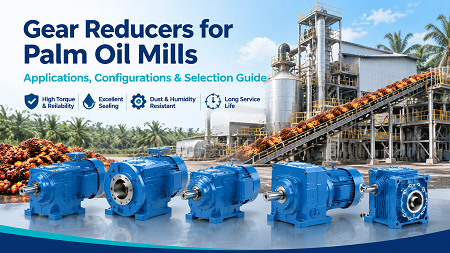
Palm oil and grain plants punish gearboxes with the same three conditions: abrasive dust, near-continuous duty, and tropical humidity. Screw presses and sterilizer cages need high torque at very low speed (K series, 3.98–197.37 ratio, up to 50,000 Nm). Bucket elevators and chain conveyors need compact parallel-shaft drives (F series). Screw conveyors and light handling need self-locking helical-worm units (S series). Specify ingress protection, seal type, and breather position as carefully as you specify torque.
A palm oil mill in Sumatra runs 22 hours a day, six days a week, in 32 °C with 85% humidity and fibre dust on every surface. A grain terminal in Mombasa runs a bucket elevator through wheat dust that behaves like a slow abrasive. In both places, the gearbox that fails is rarely the one that was undersized on torque — it is the one that was specified correctly for load and completely wrong for the environment.
This guide gives six configurations we build regularly for palm oil and grain equipment, with the numbers attached, plus the environmental specification checklist that decides whether a drive lasts three years or fifteen.
Key Takeaways
Three numbers set the frame: output torque at the driven shaft, output speed, and duty class. Motor kW alone tells you nothing.
Palm oil drives split into high-torque low-speed (screw press, sterilizer) and moderate-torque dusty conveying (FFB conveyor, kernel plant). They need different series.
K series covers right-angle heavy duty up to 50,000 Nm at 3.98–197.37:1 — the default for screw presses and cage drives.
F series is the standard for bucket elevator heads and chain conveyors where the drive must sit tight against the casing.
S series adds self-locking, useful on inclined screws and hold-and-release stations up to 4,000 Nm.
In tropical plants, seal protection and breather placement fail drives more often than torque does. Specify IP55 minimum, IP65 for washdown, and reposition the breather before installation.
Plan for spare unit availability: a mill that waits six weeks for a European gearbox loses more than the gearbox cost.
Why These Two Industries Break Gearboxes
| Condition | Palm Oil Mill | Grain Plant | What It Does to a Drive |
|---|---|---|---|
| Abrasive dust | Fibre, shell, sand | Wheat, maize, rice husk dust | Wears lip seals, contaminates oil, polishes gear flanks |
| Humidity / condensate | 80–90% RH, steam nearby | Seasonal, high in coastal terminals | Emulsifies oil, rusts bearings during idle periods |
| Duty | 20–24 h/day, 6 days | Campaign peaks, 24 h during harvest | Thermal fatigue, oil breakdown |
| Shock | Press cake slugs, cage jam | Choked elevator boot, conveyor plug | Tooth root cracking, shaft fatigue |
| Low output speed | 10–50 rpm typical | 40–80 rpm | Poor oil film at low speed → boundary lubrication |
| Washdown | Some plants hose down floors | Usually dry | Water ingress through seals and breathers |
Palm Oil Mill: The Six Drive Points That Matter
A mill has a dozen drives. These six decide throughput.
| Drive Point | Typical Motor | Output Speed | Recommended Series | Reason |
|---|---|---|---|---|
| FFB reception conveyor | 5.5–11 kW | 20–30 rpm | K or F, hollow shaft | Dust, frequent starts under load |
| Sterilizer / cage drive | 7.5–15 kW | 8–15 rpm | K, combined (K + RF) | Very high torque at low speed, heavy shock on jam |
| Thresher drum | 15–30 kW | 30–45 rpm | K, heavy duty | Impact loading, continuous |
| Digester | 15–22 kW | 25–35 rpm | K, heavy duty | Slurry, high torque, shock |
| Screw press | 11–22 kW | 40–60 rpm | K, hollow shaft + torque arm | Highest continuous torque, abrasion, 24 h duty |
| Kernel / EFB handling | 3–7.5 kW | 30–60 rpm | S or F | Light duty, compact, dusty |
Six Recommended Gearbox Configurations for Palm Oil and Grain Equipment
Configuration 1 — Screw Press Drive (The Torque-Critical One)
| Motor | 15 kW, 4-pole, 1,450 rpm, IEC B5, IP55 |
| Ratio | 1 : 30, three-stage |
| Output speed | 48 rpm |
| Output torque | ≈ 2,700 Nm continuous |
| Service factor | 1.6 (pressed cake slugs, jam-prone) |
| Design torque | ≈ 4,350 Nm |
| Selected unit | K series, K107 class, hollow output shaft + torque arm, double-lip oil seal |
Engineering Notes: Torque arm must anchor to the press frame, not the guard. Protect the output shaft with a shaft guard and grease the hollow-shaft fit with anti-seize at assembly so the unit can be removed in one shift.
Configuration 2 — Sterilizer Cage Drive (Slowest, Highest Torque)
| Motor | 7.5 kW, 4-pole, 1,450 rpm, IP55 |
| Ratio | 1 : 120 combined (helical-bevel + helical stage) |
| Output speed | 12 rpm |
| Output torque | ≈ 5,300 Nm continuous |
| Service factor | 1.8 (cage jam on discharge, reversing) |
| Design torque | ≈ 9,500 Nm |
| Selected unit | K series K157/K167 class combined unit, foot mounted, solid output shaft with coupling |
Engineering Notes: At 12 rpm the oil film is marginal — specify a low-speed lubricant grade and an oil-level window rather than a dipstick. Add a torque limiter or shear pin in the coupling if the cage can jam on fruit bunch bridging.
Configuration 3 — FFB Reception Conveyor
| Motor | 5.5 kW, 4-pole, 1,450 rpm |
| Ratio | 1 : 60 |
| Output speed | 24 rpm |
| Output torque | ≈ 2,050 Nm |
| Service factor | 1.5 (lump loading from ramp) |
| Selected unit | K97 class with hollow shaft, or F series if frame width is limited |
Engineering Notes: Specify a dust-tight seal guard (labyrinth or felt-plus-lip) on the output side. Loose fibre wraps a plain lip seal and pulls it out within weeks.
Frame sizes above are indicative for the stated ratio and speed. Confirm against the current catalog rating at your exact input speed before ordering — a 60 Hz motor raises input speed to 1,750 rpm and shifts the rating.
Grain Plant: Four Drives, Four Different Answers
| Drive Point | Typical Motor | Output Speed | Recommended Series | Reason |
|---|---|---|---|---|
| Bucket elevator head | 7.5–22 kW | 50–65 rpm | F series, hollow shaft + torque arm | Slim body against the casing, high radial load from the head pulley |
| Chain conveyor / drag | 5.5–15 kW | 25–40 rpm | F or K | Shock from choked inlet, dust |
| Screw conveyor / auger | 3–11 kW | 30–50 rpm | S series | Self-locking on incline, compact, cost-effective |
| Dryer / aspiration fan | 11–30 kW | 400–600 rpm | R series single-stage | Inline, high speed, efficiency above 95% |
| Grain cleaner / separator | 2.2–7.5 kW | 200–300 rpm | R series or belt drive | Smooth, low torque |
Configuration 4 — Bucket Elevator Head Drive
| Motor | 11 kW, 4-pole, 1,450 rpm, IEC B3, IP55 |
| Ratio | 1 : 25, three-stage |
| Output speed | 58 rpm |
| Output torque | ≈ 1,720 Nm |
| Service factor | 1.6 (choked boot at start) |
| Design torque | ≈ 2,750 Nm |
| Selected unit | F series F87/F97 class, hollow output shaft, shrink disc, torque arm |
Engineering Notes: The head shaft carries the belt tension as well as torque. Calculate radial load at the shaft end and check it against the allowable — this is where bucket elevator drives break shafts. Use a shrink disc rather than a keyway on reversing or high-start-frequency elevators.
Configuration 5 — Screw Conveyor (Auger)
| Motor | 7.5 kW, 4-pole, 1,450 rpm |
| Ratio | 1 : 40 |
| Output speed | 36 rpm |
| Output torque | ≈ 1,750 Nm (at 88% helical-worm efficiency) |
| Service factor | 1.5 |
| Design torque | ≈ 2,600 Nm |
| Selected unit | S series S97 class, foot mounted, solid output shaft |
Engineering Notes: The worm stage gives self-locking, so a loaded inclined auger will not run back on power loss. Efficiency at 50:1 sits around 88% — if the conveyor runs 24/7, compare the energy cost against an F or K series before deciding.
Configuration 6 — Grain Dryer / Aspiration Fan
| Motor | 15 kW, 2-pole or 4-pole, 1,450 rpm |
| Ratio | 1 : 2.8, single stage |
| Output speed | ≈ 520 rpm |
| Selected unit | R series single-stage (RX class) or belt drive |
Engineering Notes: Fans are high-speed, low-torque, continuous duty — the case where inline efficiency above 95% pays for itself. Watch vibration: fan imbalance destroys bearings long before the gears notice.
Need a Gear Reducer for Your Palm Oil or Grain Processing Plant?
Tell us your equipment type, motor power, output speed, torque requirements, and working environment. Our engineers can help recommend a suitable gearbox configuration.
Request a Gearbox SelectionThe Specification Checklist That Decides Service Life
Torque gets you the frame. These items get you fifteen years.
1. Ingress Protection
IP55 is the floor for both industries. Specify IP65 for washdown areas, floor-wash zones, and outdoor installations. Confirm the motor matches the gearbox rating — a mismatched IP is a false economy.
2. Seals
Standard lip seals are not enough in fibre dust. Ask for double-lip seals with a dust guard, or a labyrinth cover on the output side. On screw press and FFB conveyors, wrapped fibre will destroy a plain lip seal in weeks.
3. Breather and Drain Position
The breather must sit at the highest point for the actual mounting position, and the drain at the lowest. Mounting position also sets the oil level mark — M1 through M6. This single item causes more warranty claims in tropical plants than any mechanical fault, because a breather left in the shipping position admits humid air and condensate.
4. Coating and Materials
Cast iron housing with a multi-coat epoxy finish for humid, mildly alkaline environments. Stainless output shafts (SS304/316) where washdown is routine. Zinc-plated fasteners, not painted.
5. Lubricant
Match the oil to the ambient range and the output speed. Low-speed drives (under 20 rpm) need a grade that maintains film at low sliding velocity. Ask for the oil specification in writing so the plant can source it locally — a mill that cannot buy the right oil will use the wrong one.
6. Storage and Commissioning
Gearboxes stored outdoors in the tropics condense internally. Keep units sealed until installation, fill to the correct mark on site, and change oil after the first 500 hours — the run-in period generates the most metallic debris of the unit's life.
7. Alignment and Belt Tension
On chain and V-belt drives, misalignment and over-tension are external failures that get blamed on the gearbox. Align to the coupling manufacturer's tolerance, tension belts with a gauge, not by feel.
Buying for a Mill or Terminal: What Actually Matters
For a distributor or a plant purchasing manager in Indonesia, Malaysia, Kenya, Tanzania, or Nigeria, three commercial points usually decide the supplier:
Lead time. Producing countries run campaigns. A gearbox that arrives after the harvest peak has no value. Standard units ship in 7–15 days from our China facility, and stocked parts allow fast assembly of non-standard ratios.
Voltage and flange compatibility. 380 V/50 Hz in Indonesia, 415 V/50 Hz in Kenya, Nigeria, and Malaysia, 440 V/60 Hz in parts of Latin America. IEC and NEMA flanges both available — matching the existing motor frame avoids an adapter plate and a misalignment problem.
Spare unit availability and documentation. A plant that keeps one spare K107 on the shelf avoids a two-week stop. Ask for dimension drawings and a parts list at order stage, not after a failure.
Manufacturing and Customization Capabilities
Our K series units use 20CrMnTi alloy steel case hardened to 58–62 HRC, CNC-ground to DIN 6 accuracy, and every unit is load, noise, and oil-leak tested before it is packed into a fumigation-free plywood crate. Custom output flanges, shaft dimensions, and ratios are machined in-house, so a replacement drive can match an existing footprint rather than forcing a re-design.
Send us the drive point, motor kW, required output speed, and site conditions and our engineers will return a frame selection with a 3D CAD model within 48 hours. Request a palm oil or grain drive selection.
Get a Customized Gearbox Solution for Your Processing Plant
Whether you operate a palm oil mill, grain terminal, bucket elevator, screw press, or conveyor line, our team can help evaluate your operating conditions and gearbox requirements.
Send Your Project RequirementsFrequently Asked Questions
1. Which gearbox is used in a palm oil screw press?
A helical-bevel (K series) hollow-shaft unit with a torque arm is the standard choice — typically a K107-class frame for a 15 kW, 1:30 drive producing about 2,700 Nm at 48 rpm, with a service factor of 1.6 for jam conditions. Right-angle output keeps the motor clear of the press body.
2. Why do gearboxes fail early in palm oil mills?
Almost always environment rather than load: fibre dust destroying lip seals, breathers left in the shipping position admitting humid air, condensate in the oil, and the wrong oil grade for 12–20 rpm output speeds. Specify IP55 minimum, double-lip seals with dust guards, correct breather position, and low-speed lubricant.
3. What gearbox does a bucket elevator need?
A parallel-shaft (F series) hollow-shaft unit with a shrink disc and torque arm, sized on both torque and the radial load from the head shaft. An 11 kW, 1:25 drive at 58 rpm needs roughly 2,750 Nm after a 1.6 service factor. Always check allowable radial load at the actual load position.
4. Can one gearbox series cover both palm oil and grain equipment?
No. Screw presses and sterilizer cages need high torque at 8–50 rpm, which suits the K series up to 50,000 Nm. Bucket elevators and chain conveyors need compact parallel-shaft drives. Screw conveyors benefit from the self-locking S series up to 4,000 Nm. Mixing series by convenience usually costs efficiency or service life.
5. Do you supply explosion-proof or ATEX versions for grain dust?
Explosion protection is a motor and installation issue as much as a gearbox one. Tell us the zone classification and the required marking at inquiry stage and we will confirm what can be quoted for your market. Do not assume a standard TEFC motor satisfies a dust-rated installation.
6. What is the lead time and minimum order for these drives?
Standard configurations ship in 7–15 days from our China facility. Low MOQ is accepted for trial orders, and OEM branding, custom shafts, and non-standard flanges are available. Trade terms include FOB, CIF, and DDP.
Looking for Gear Reducers for Palm Oil or Grain Processing Equipment?
Send your motor specifications, required output speed, equipment type, and operating environment. Get professional gearbox selection support and a customized quotation for your project.
Contact Our Engineering Team